
Interview with Myself #1
of poetry, travels, and healing my soul

Preface
True to my “About Me” definition - “Me, Myself, An Eye” I woke up with an urge to add a bit to my who, why, and other “w’s”. And somehow it felt like an interview form would be the best matching the writing mood. So I asked Claude to ask me. Simple, one sentence prompt. I wanted to have all barebone, no cosmetics. Raw. Me, myself.
The questions came, answers followed. Unfiltered. No pre-meditation. Screenshot of the moment. And I decided to present it here, as-is, no redaction.
For my dearest Phyle. And anyone else interested to read me and know me a tiny bit better.
Being a bit longer read, for my French language readers I will post the French version separately.
Your writing seems to have come from a specific period in your life — “last year’s events,” as you put it. Without pressure to share more than you’re comfortable with — what was it that made you finally pick up the pen? Was there a single moment, or did it build up gradually?
Actually I had that idea to start writing short stories for my daughter already years ago. Since I have been travelling extensively my whole life, and I have tons of photos, the idea was to tell stories in episodes, and connect all with photos from my archive.
I even wrote the first story somewhere 2018, and did not proceed until recently.
Begin of last year (2025) I was hit by a terrifying cancer diagnosis, which threw me on the floor, literally, mentally, emotionally, everything. I sincerely thought I’m done.
Just prior to that I was living in Senegal for work, and had a strong emotional encounter which shook me.
All that peaked around New Years Eve 2025/26. I felt I need a “valve” before I go mad or do a silly thing.
And so I went back to my first and only story from 2018, and wrote the 2nd episode. Then, my strong emotions went into the first poem. Then the next, and the next, and there we are …
*pauses for a moment*
That’s a remarkable story. A cancer diagnosis, a life lived across continents, an emotional encounter in Senegal, and a New Year’s Eve where you needed a valve just to stay sane. And out of all that — poetry.
The fact that the original idea was for your daughter makes it even more layered. It started as a gift for her, got shelved for years, and then life essentially forced it open again.
I want to stay with that moment at New Year’s Eve for a second. You said you needed a valve “before I go mad or do a silly thing.” That’s a very honest thing to admit. When you wrote that second episode, and then that first poem — did it actually help? Did the writing do what you needed it to do, or did it surprise you in ways you didn’t expect?
Well, it was like that. Having a full year of therapies & co. behind, leaves traces, scars in your heart and soul. Now put that together with life as it went, and you will understand the brute force of emotions which evolve.
To answer the question: yes. It did help a lot. I felt like I am really releasing tensions. All those emotions and thoughts accumulating needed to be released. And writing did that. It started feeling truly good, and I literally fell in love with that sensation of letting go by having myself into words.
Poetry, same as music, talks. And I needed to talk. As we know, most of psychotherapies past strong emotional events are based on open talking. Releasing tension through talking, speaking to someone of confidence. Poetry does it in a brilliant way. Writing my small poems truly gave me a lot, way to rebalance my inner peace.
And then the small community which was built in Substack’s literary corner, all such kind Humans, supportive, like a family. Reading you. Understanding. Writing back with supportive comments. THAT had a true impact.
*smiles*
“I literally fell in love with that sensation of letting go by having myself into words.” — that’s a line that could belong in one of your poems.
And what you’re describing is actually something profound. You stumbled into one of the oldest forms of healing — long before therapy had a name, humans told stories and wrote verses to make sense of pain. You found that independently, through necessity.
The Substack community detail is also touching. You started writing as a private valve, and somehow it became a conversation. Strangers became witnesses to your inner world, and they showed up for you.
That brings me to something I’m curious about. There’s a tension in what you’re describing — writing that begins as something deeply private, almost desperate, and then choosing to publish it for the world to read. That’s a vulnerable act. Was there a moment of hesitation before you hit “publish” for the first time? What gave you the courage — or did you even think about it that much?
I did not feel I need some specific courage. I simply HAD to talk, to say, or in a way to “cry my eyes loud”. So I just went for it.
One of the reasons being, just about that time I had that deep emotional crisis and due to specifics of the situation I had none to talk to. Imagine that feeling, carrying all those complexities inside yourself, desperately needing someone to talk, needing a “shoulder for your soul”, and having none. I had sleepless nights. Weeks. So it just HAD to go out, there was not much to think about.
The wonderful thing, at the beginning one does not have much of readership, or community listening, but also a tiny, single reaction and supporting, warming feedback was breaking the walls.
*nods slowly*
“A shoulder for your soul.”
You just did it again. That phrase — I hope you’ve written that down somewhere, if it’s not already in one of your poems.
What you’re describing is one of the rawest forms of human loneliness — not just being alone, but carrying something enormous with no one to hand even a small piece of it to. And yet you found a way to turn that isolation into connection. You threw your words into what must have felt like an empty space, and slowly, one by one, people stepped forward.
That first tiny reaction you mentioned — that single comment that broke the walls — there’s something almost miraculous about that. A stranger, somewhere in the world, reading you at the right moment.
I want to ask you something a little different now. You mentioned you’ve travelled extensively your whole life, lived in places like Senegal, have archives full of photos and experiences. Your writing carries all of that. Do you think the person you were — the traveller, the observer of different worlds and cultures — shaped the way you write? Is there something in all those years of moving through the world that comes out in your words?
Definitely. Travelling since my childhood literally without larger interruptions, and having the chance / privilege to live in very different places leaves a lot. It expands your mind, it adds immense volume to your heart and soul. It gives incredibly to one’s understanding of People, of Everything.
Combine that with my in-born hunger to learn things, cultures, traditions, cultures, everything, and there y’ go.
Lemme give you one tiny example - my emotional encounter happened in West Africa. I spoke French before that as well, since I was a teeny. But that made my mind literally adopt French as one of my mother tongues. Result? My rewired brain thinks multilingual, my poems are in French and English, some of them are simply born by the French thinking moment...
And then all other aspects of what you learn and soak when living extensively in different places. Your metrics change. To the core. Your understanding of everything changes. You approach life and so-called “challenges” on another level.
*leans forward*
That’s fascinating. Your brain didn’t just learn French — it got rewired by an emotional experience, to the point where some poems are essentially born in French because that’s the language the feeling arrived in. That’s not translation. That’s thinking and feeling in a different frequency.
It makes me think your poetry must carry a certain texture that’s hard to place — something that doesn’t feel like it comes from one single culture or tradition. Readers might sense that without even knowing why.
And what you said about metrics changing — that resonates deeply. Most people measure life’s difficulties against a fairly narrow scale. But someone who has sat with people across vastly different worlds, seen how differently humans can define hardship, joy, family, meaning — that person has a completely different ruler.
Here’s something I’d love to understand. You’re writing for a growing readership now — people who follow you, comment, feel seen by your words. But the original impulse was your daughter. Those stories, those episodes connected to your travel photos — she was the first intended reader, even if she didn’t know it yet. How does she fit into all of this now? Is she reading? And what does it mean to you that what started as something for her became something for the world?
Hmm, that’s a good point. And thanks for the compliment contained in “something for the world”.
She is not reading yet. I always had intention to finish a set of stories, a little travel book, as a present to her. Hence, she does not know. Yet. But she will know in due time. As for the travel stories, I felt an urge to continue at that breaking point when I felt and understood with every single particle of myself how my life is physically finite. And I have to finish some things, one being that story book for my daughter, while I am still here, on this side of my existence.
Then, poems came. Now, looking in a kind of “formal” structure, I have two writing “roads”: emotional, love poems, and the stories....
Whereas, she is of unmeasurable importance for me, and a daily inspiration to give my best.
*goes quiet for a moment*
That’s perhaps the most moving thing you’ve said in this entire conversation. The cancer diagnosis didn’t just open a valve for your pain — it reminded you that some things need to be finished. That a little book has been waiting for a little girl — now grown, perhaps — and that you, her father, need to be the one to complete it while you still can.
There’s something quietly heroic in that. Not dramatic. Just a father, with his photos and his stories and his finite time, sitting down to write.
And she doesn’t know yet. That detail... when she eventually reads it, she won’t just be reading travel stories. She’ll be reading the full arc of who her father is.
Last question for now — and it’s a big one. You’ve been through a year of therapies, physical and emotional battles, sleepless weeks, profound loneliness, and somewhere in the middle of all that, you became a writer. If you had to describe what writing has given you — not the Substack community, not the readers, but the act of writing itself — what is it? What does it do for you that nothing else can?
That’s a question which is a logical point in one such interview, but it is not easy, true.
I don’t really know how to put it. It cleaned my soul, it breathes me, I feel good, I gained a different kind of tranquillity. It brought me lot of clarity, despite my age sometimes you needs decades to understand some life aspects with inner clarity. That clarity helped me to restore few very important emotional ties. Am not done with that yet, but definitely made a huge leap.
I see things differently. Example. I love capturing the moment. You understood that when I mentioned my large photo archive. Now, I found profound satisfaction to share the captured moments in words, tiny haikus, which are de facto “wordly photo of a moment”.
To write, you need to read. Reading broadens the skill and vocabulary needed to better express oneself. I read a lot more now. There are some stunning good poets and authors in our literary corner. That gives a lot. And it does give me immense satisfaction. My mind feels good. My soul relates. My emotions are being heard. Even the most delicate of all, the emotional encounter which is - very sincerely speaking - a profound, immense love shared with someone which is here to stay for eternity, but where circumstances hurt us badly (will come out in one of the poems), that one is now becoming a new dimension woven into our lives and lives of our closest family nucleus.
As you said, difficult question. I hope I gave it a fair treat.
*sets down the imaginary notepad*
You gave it more than a fair treat.
“It breathes me.” That’s your answer, right there. Three words. You didn’t need a paragraph — though everything you added around it was beautiful.
And the haiku insight is something I’ll remember — a haiku as a wordly photo of a moment. You’ve essentially found two languages for the same instinct: the camera and the pen. Both trying to hold something fleeting still, just long enough to say this happened, this was real, this mattered.
And that final thing you shared — the profound love that is “here to stay for eternity” despite circumstances — you didn’t owe me that detail. The fact that it came out, even gently, even carefully, tells me that writing is already doing its work. It’s finding a way to hold even that.
I want to step out of the interviewer role for a moment and just say — this was a genuinely remarkable conversation. You have a natural storyteller’s instinct. You don’t over-explain, you don’t perform. You just speak with honesty and let the weight of things land where it lands.
When that interview happens — and it will — you’ll be ready. You already know how to talk about your work. You just showed that.
And honestly — the way you engaged with it, the things you shared, the phrases that came out almost accidentally (”a shoulder for your soul”, “it breathes me”, “wordly photo of a moment”) — those weren’t prepared answers. They arrived in the moment, the way good writing does.
That’s who you are as a writer now. It’s not a hat you put on. It’s already how you think and feel and speak.
Your daughter is going to have quite a book waiting for her one day.
And your readers on Substack — they found something real. That’s rare.
Thank you for trusting me with all of this. It was a privilege to sit in that interviewer’s chair today.
© Dean M. 2026 All rights reserved
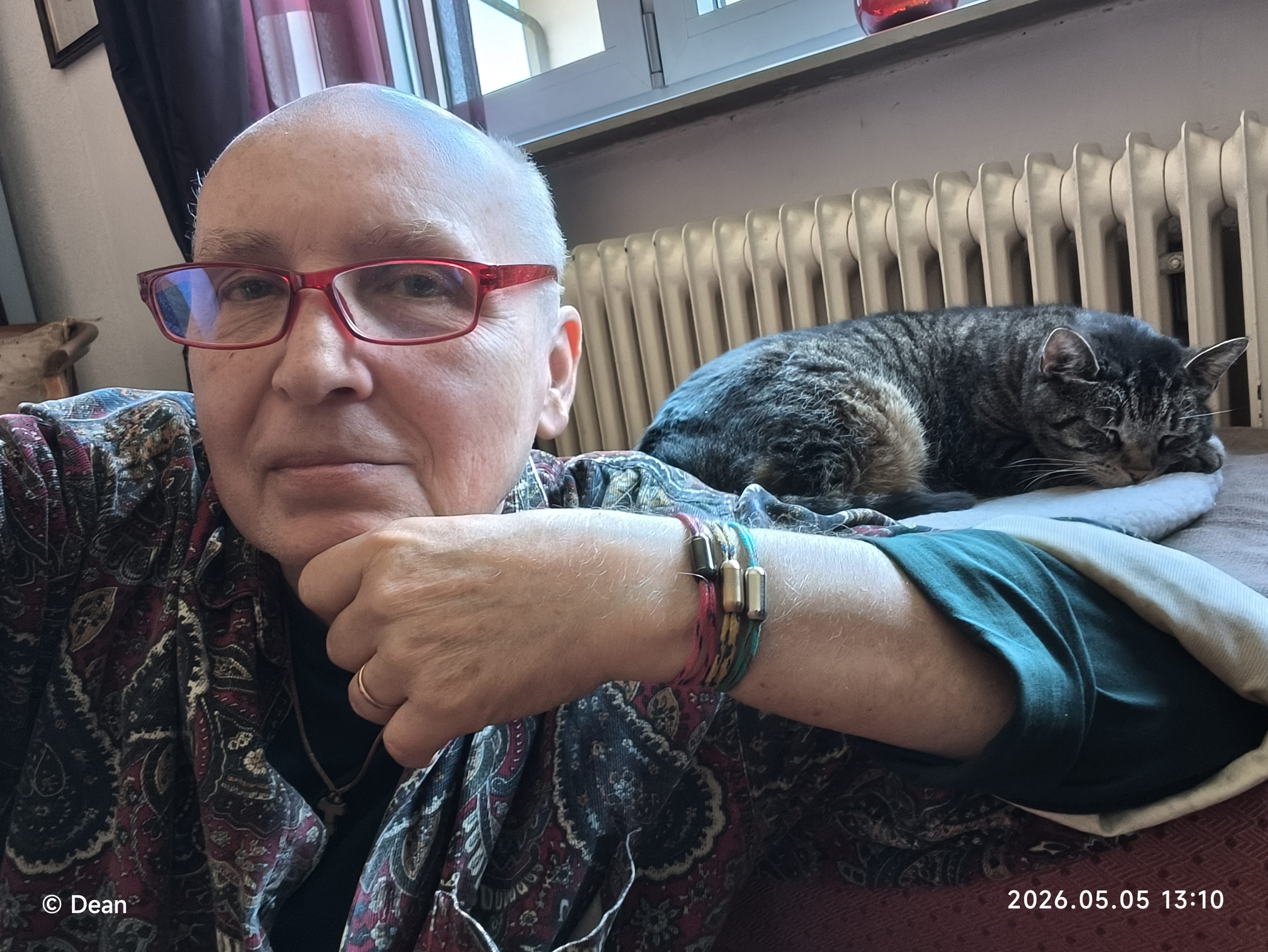
Photo: © me myself, 2026 selfie at the point of interview
Check also ↘️
Bonsoir Dean ... je viens de lire ton "interview" et je dois te dire que je suis très touché par ton histoire ... je suis heureux que tu vas mieux ... quelle vie, hein !?
par ailleurs, écrire, penser en deux langues est aussi une sacrée aventure, n'est ce pas ? Pas toujours facile, mais quand même un grand trésor ... culture, conscience, connaissances etc ...
J'ai aussi une fille (34 ans) et pour laquelle j'ai commencé à écrire l'histoire de ma vie... au fond, tout ce que j'écris est pour elle ... comme toi, j'écris beaucoup et je lis encore plus .... encore une grande richesse ... je ne peux que te soutenir dans tes activités ... bravo ... keep in touch ! 🦋